
Published Aug 5, 2026
Picture this: the marketing team walks into the end-of-month meeting with numbers that look excellent — strong engagement on Instagram, a healthy volume of inquiries from Facebook ads, positive comments, maybe even a lower cost-per-lead than last month. Everyone's satisfied... except the sales team. From where sales sits, most of these inquiries are "not serious" — they ask about price once and disappear, or they don't have the budget or the authority to actually buy. And by the end of the month, actual revenue hasn't moved, even though every marketing metric is "working" on paper.
This contradiction repeats across dozens of small and medium businesses I've worked with: marketing "succeeds" by its own metrics, while sales quietly absorbs the consequences of receiving effort that was never built to serve it in the first place. The problem here isn't a lack of effort or weak creative work — it's the absence of a direct link between what marketing does and what the sales team actually needs to close a deal.
In this article, I'll explain what Sales-Linked Digital Strategy is — the first of the Growth Machine's six pillars — why marketing fails to move sales even when it "works" on the surface, the signs that your business suffers from this gap, and the practical steps to start closing it this week.
What Is Sales-Linked Digital Strategy?
Sales-Linked Digital Strategy simply means: every marketing decision — channel choice, content topic, ad targeting, even the messaging angle — is built starting from one question: "Will this bring a real prospect closer to closing a deal?" — not from the question "Will this look good in the monthly report?"
This is the opposite of what I call "Visibility-First Marketing": the default pattern most small and medium businesses fall into, where the success of every marketing activity is measured by its own reach and engagement, completely disconnected from what happens to that inquiry once it reaches the sales team.
The difference isn't budget, or even creative execution quality. The difference is simply: where do you start? Do you start from "what grabs attention?" — or do you start from "what actually convinces a real prospect similar to the customers we've already closed real deals with?"
Why Marketing Fails to Move Sales, Even When It "Works" on the Surface
Through my work with dozens of companies, I've noticed this gap repeats in three specific patterns:
The Reach Mirage
Content optimized to maximize likes and shares, with no regard for whether the audience it reached actually resembles your real prospects at all. Wide reach isn't a goal in itself — it's only useful if it reaches the right people.
The Lead Quantity Trap
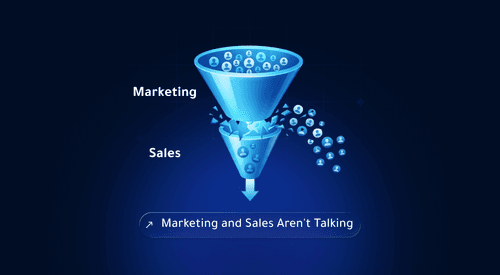
Campaigns optimized to maximize the number of inquiries at the lowest possible cost per lead, with no filter for quality or fit. The result: a large volume of unqualified contacts gets dumped on the sales team, who waste their time on them, then conclude that "marketing leads are all junk" — when the real problem is how the campaign was targeted, not sales itself.
The Message Mismatch
The marketing message and product positioning are built completely disconnected from what the sales team actually hears in real conversations — the objections, the hesitation, the real reasons a prospect decides or doesn't decide to buy. So ads arrive with the wrong expectations, or fail to pre-address the real objections that will surface later in the sales conversation.
Without a clear link between what marketing does and what the sales team actually hears and needs, the company keeps repeating the same effort month after month, while the numbers keep "looking good" only at the marketing level — the exact opposite of the real goal of any marketing investment.
Signs Your Marketing Isn't Linked to Your Sales
Before getting into the solution, check: does your business actually suffer from this gap? Here are six very common signs:
- Marketing's monthly reports "look good" on paper — but your sales team describes the inquiries as weak or not serious.
- No one can say exactly which campaign, channel, or piece of content actually led to a signed deal last quarter.
- Marketing and sales use two completely different definitions of what a "qualified lead" even means.
- The content calendar gets built without ever consulting sales about what prospects actually ask, or the objections they run into.
- Ad targeting relies on broad demographics or general interests, not the actual profile of customers you've already closed real deals with.
- Marketing's success is measured in reach and engagement, sales' success in revenue — and no one puts the two numbers side by side to compare them.
If you recognize three or more of these, that's a strong signal your marketing is operating disconnected from your sales — and that's exactly what Sales-Linked Digital Strategy fixes.
A Quick Illustration: From "Good Numbers" to Real Sales
Let's walk through a common hypothetical example: a small B2B services company launches a lead-generation ad campaign and gets a good volume of inquiries at a low cost per lead. The marketing team celebrates the apparent "efficiency" of that number. But the sales team converts almost none of these inquiries into actual clients.
On diagnosis, it turns out the ad targeting attracted curious price-shoppers who click without real buying intent, not qualified prospects — because the campaign was optimized purely for the cheapest cost per inquiry, with zero connection to the actual profile of customers the company had already closed real deals with, an input marketing never used despite having it available.
The fix here wasn't a bigger budget — it was rebuilding the targeting and the ad messaging based on the real profile of the last 10 closed-won customers: who they were, what actually convinced them, and which objections nearly stopped the decision. After this one change, the total number of inquiries dropped and the cost per inquiry rose on the surface — but the conversion rate into actual signed deals rose noticeably, because "sales-linked" targeting brings in fewer prospects, but far better-fitting ones, so real revenue goes up even when the surface-level marketing numbers look "worse."
The Five Components of Sales-Linked Digital Strategy
Building a digital strategy that's genuinely linked to sales rests on five interconnected components:
Start from closed deals, not from content ideas
Every campaign or content plan should begin by analyzing the most recent closed deals — both won and lost: what actually convinced the customer? What nearly cost the deal? Where did they first hear about the company? This simple analysis, which requires no complex tool, often reveals a repeating pattern no one had noticed before, and becomes the real starting point for the next campaign — instead of the question "what looks trendy right now?"
A shared definition of a qualified lead
Marketing and sales agree in writing, before any campaign launches, on what actually makes a prospect "sales-ready" — a clear budget signal, a real need, access to the decision-maker, a defined timeline. Without this written agreement, each side keeps judging inquiries by its own personal standard, and any disagreement turns into a personal argument instead of a shared reference point everyone can return to.
Objection-aware messaging
Content and ads directly address the top 3-5 objections the sales team actually hears in real conversations, instead of settling for a vague, generic value proposition. When a prospect reads an ad that has already answered the hesitation they were about to feel, they arrive at the sales call already halfway there, instead of the sales team starting from zero every single time.
One shared success metric
Instead of a separate report for each team with its own metrics, both teams agree on one metric they're jointly accountable for — like revenue attributed to the campaign, or the rate of qualified meetings booked — so that marketing only "wins" when sales actually wins too. This doesn't mean scrapping each team's internal metrics, it means adding one metric above them that pulls both in the same direction.
A continuous feedback loop, not a one-way handoff
A short recurring sync (weekly or biweekly) where the sales team tells marketing exactly what happened to the inquiries they were sent, so campaigns get adjusted based on a real signal from the ground, not just ad-platform analytics. Without this loop, marketing keeps repeating the same targeting every month, with no idea what actually happened to what it sent last month.
Why This Matters Specifically for Algerian SMEs
In most small and medium businesses in Algeria, marketing is often run as a completely separate activity — sometimes through a freelancer or an outside agency — while sales stays in the hands of the founder or a small internal team, and the two sides rarely talk on a regular basis. Marketing optimizes for whatever is easy to measure and present as "proof of work" (likes, reach, number of inquiries), while sales quietly absorbs the consequences of low-fit inquiries, without that frustration ever reaching whoever is planning the campaigns.
Closing this gap doesn't require extra budget or a bigger team — it just requires a conscious decision to connect the two functions through shared definitions and a regular feedback loop, no matter how small the company is, and no matter how few people are responsible for marketing and sales — even if it's the same person wearing both hats.
And more importantly: companies that make this connection early save themselves years of spending on campaigns that "look successful" without ever knowing the real reason their actual sales growth keeps stalling.
5 Steps to Start Building Sales-Linked Digital Strategy This Week
- Honestly review your last 10 closed deals. Write down in plain language what actually convinced each customer, and what nearly stopped their decision. This exercise alone often reveals patterns that weren't obvious before.
- Sit with your sales team for just 30 minutes. Write down the top 5 objections they hear regularly, and start using them directly in your next round of ad copy and content.
- Write one shared definition of a "qualified lead" in a single clear sentence, agree on it with sales, and share it across both teams.
- Honestly audit last month's campaigns: which one actually produced a signed deal, not just inquiries or clicks? Stop or fix any campaign that produces inquiries with zero real deals.
- Set a fixed 15-minute weekly sync between whoever runs marketing and whoever runs sales — no more, no less — to permanently close the feedback loop, not just once.
Common Mistakes to Avoid
Judging a campaign's success by cost-per-lead alone
Ignoring what happens to those leads afterward hides the real problem instead of solving it.
Letting marketing and sales run on two completely separate dashboards
Without a direct comparison side by side, the gap keeps going unnoticed.
Building the marketing message on what the founder personally thinks "sounds convincing"
Instead of what real closed-deal data actually proves.
Treating this as a one-time alignment meeting
Instead of an ongoing weekly habit. Alignment decays fast without a recurring touchpoint.
Frequently Asked Questions
What's the difference between a marketing KPI and a sales-linked KPI?
A marketing KPI (reach, engagement, followers, cost-per-lead) measures whether an activity performed well in isolation. A sales-linked KPI measures whether that same activity actually moved a prospect closer to becoming a paying customer — and the two can move in completely opposite directions.
Does this mean I should stop tracking reach and engagement altogether?
No — reach and engagement remain useful supporting signals, but they should never be the sole final measure of success on their own. Track them, but always alongside what happened to those prospects afterward in the sales process.
What if my business doesn't have a separate sales team, and I handle sales myself?
This applies to you directly, and maybe even more so — since you're the one with first-hand knowledge of the real objections and the real reasons deals close or don't, so use that direct knowledge to shape your own campaigns instead of copying generic ad templates that have nothing to do with your reality.
How do I get marketing and sales to agree on what a "qualified lead" even means?
Sit down together (even if it's just you wearing both hats) and write one sentence answering: "What does a lead need to have or show before we consider it worth real sales time?" — a budget signal, a real need, a decision-maker, a timeline. Write it down, and use it to judge every campaign afterward.
Does this only apply to paid ads, or organic content too?
It applies to both equally. Organic content can answer real customer objections and questions just as effectively as ads do — a post or video that pre-answers an objection the sales team hears constantly can move an ordinary follower toward becoming a serious prospect, just as effectively as any paid ad.
How soon can I expect to see sales improve after making this shift?
Some effects show up quickly — the quality of sales conversations around new inquiries improves from the very first adjusted campaign. But the full, compounding effect, where the whole pipeline reflects the shift, usually takes one to two full sales cycles to show clearly, since that depends on how long your average deal typically takes to close.
Conclusion
Marketing that "works" without moving sales isn't actually succeeding — it's just producing activity that looks good on paper. Sales-Linked Digital Strategy replaces that false proof of work with a real, provable link between what marketing does and what sales actually closes. The five steps above cost nothing but time and honesty between two teams — or two hats you wear yourself — and they're the same starting point I use with every client before we touch a single ad dollar. In the next article, we'll move to the second pillar: Scalable Lead Generation Systems. And if you'd rather have an outside, objective diagnosis of exactly where your marketing and sales are disconnected, I'm here to help.